Finding a dependable China-based manufacturer for a 9V AC DC power adapter takes more than comparing prices. Buyers need to understand output requirements, connector types, polarity, input range, and intended operating conditions. The search term “Ac Dc Power Adapter 9v” can describe products with very different specifications. A suitable unit should match the equipment, not just the voltage printed on its label. Details matter.
A careful supplier review can help reveal whether a factory has relevant production experience, documented quality checks, and clear communication. Ask how it verifies output voltage under load, checks cable and connector dimensions, and handles sample approval. Request technical documents and confirm that any stated certifications apply to the exact model and destination market. Do not rely on a logo or a polished catalog alone. That sounds obvious, but it is easy to overlook when deadlines are tight.
This guide explores what buyers can assess when comparing manufacturers, from engineering support and customization options to production consistency and after-sales response. It also considers practical questions to ask before placing an order. No single supplier is best for every project; minimum order quantities, lead times, and testing needs can change the decision. Some product pages may leave important details unclear. That is a reason to ask for evidence, not to assume the worst—or the best. A grounded comparison helps buyers choose an adapter and supplier with fewer surprises.
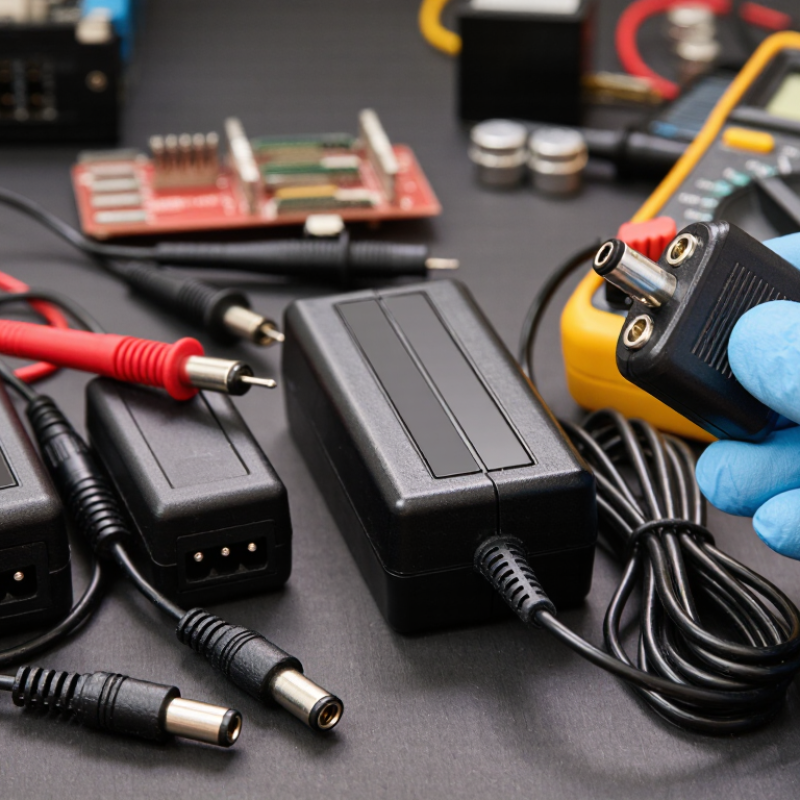
A 9V AC/DC power adapter supplies a device with a lower voltage than a wall outlet. Its input usually accepts mains AC, while its output may be 9V DC. The wording can be confusing. Some listings use “AC/DC” to describe the adapter’s input and output; others use it loosely. Check the output label before choosing one. A 9V AC output is not interchangeable with 9V DC unless the device specifically allows both.
Look for more than the voltage. The adapter’s current rating must meet or exceed the device’s requirement, and the plug must fit securely. For DC models, confirm polarity, often shown by a small diagram near the output details. A center-positive plug will not suit every device. Check whether the output is regulated, too; an unregulated supply can produce a higher voltage under light load. These details matter on a workbench, where a mismatched supply may cause erratic operation or damage. I have seen the label overlooked because the plug looked right. It is an easy mistake. A clear product specification should state input range, output type, voltage, current, polarity, and connector size.
A 9V AC adapter and a 9V DC adapter are not interchangeable by default. AC output alternates direction; DC output maintains polarity. An AC-powered device may need a transformer-based supply, while a DC device usually expects a stated polarity and stable voltage. Check the device label before comparing plugs. The connector can fit and still be wrong.
Design choices affect heat, size, and output quality. Linear DC supplies are simple, but often waste more energy as heat. Switching designs are lighter and can regulate voltage across changing loads. Compare rated current, voltage under load, ripple, and polarity—not just “9V.” For AC models, check the rated output current and frequency. A compact casing may run warm. That deserves attention.
Efficiency figures offer another useful check. The U.S. Department of Energy’s Level VI external-power-supply requirements set a 0.1-watt no-load limit for many single-voltage supplies rated at 49 watts or less. This is a benchmark, not proof that every 9V adapter meets it. DOE test procedures also assess active-mode efficiency. Ask suppliers for test results under load, plus safety and insulation documentation. One weakness in quick comparisons: buyers often overlook cable voltage drop, which can leave a device receiving less than 9V.
For a 9V AC/DC adapter, a Chinese manufacturer should meet the safety rules required in each destination market. Ask for test evidence against GB 4943.1-2022 and IEC 62368-1, where applicable. These standards assess electric shock, insulation, fire, and abnormal operation risks. Small details matter. Request the exact model number, rated input and output, and test report; a certificate for a similar model is not enough. The report should also show checks for dielectric strength, leakage current, and temperature rise under load.
EMC testing matters too. Ask whether the product meets applicable limits for conducted emissions, radiated emissions, and immunity, including relevant IEC 61000 test methods. Efficiency deserves equal attention. European Commission Regulation (EU) 2019/1782 sets a 0.10 W no-load limit for covered external power supplies rated up to 49 W. That is a useful benchmark, but market rules can differ. Ask for measured no-load power and active-mode efficiency, not just a label. I would also check factory inspection records and component traceability. Paperwork can look complete, yet leave a gap. A current, model-specific laboratory report is more convincing.
Adapter input ratings and applicable safety requirements depend on the destination market. Typical nominal supplies shown are China 220 V, the United States 120 V, the European Union 230 V, Japan 100 V, and the United Kingdom 230 V. Japan’s mains frequency varies by region (50 or 60 Hz). Manufacturers should verify the applicable national requirements and product certifications for each market; IEC 62368-1 is a commonly used product-safety standard for audio/video and information and communication technology equipment.
A reliable supplier should be able to explain exactly what “9V” means for its adapter. Check whether the output is AC or DC, then confirm polarity, connector size, rated current, and input range. These details must match your device, not just the product listing. Ask for a specification sheet and a sample with the same cable and plug you plan to order. Small differences matter.
Test the sample under realistic conditions. Measure output voltage with no load and while the device is operating. Leave it running for several hours and check for unusual heat, buzzing, or voltage fluctuation. Ask how the factory controls component changes between production batches. Request relevant test reports, and verify that their scope covers the exact model and configuration. Ask for evidence.
Look beyond price. Review the manufacturer’s inspection process, defect handling, sample lead time, and ability to share production updates. Clear answers are useful; vague promises deserve follow-up. A polished brochure can still leave gaps, and a technically sound sample does not guarantee every batch will match it. That uncertainty is worth discussing before agreeing on order quantities, packaging, or delivery schedules. The best evaluation is specific, documented, and based on the adapter your equipment actually needs.
Choosing a 9V adapter starts with the load, not the catalogue description. Confirm whether your equipment needs 9V AC or regulated 9V DC; they are not interchangeable. Record operating current, peak demand, connector dimensions, polarity, and acceptable ripple. Measure the load. A device that draws 700 mA continuously may still need extra capacity during startup. I would leave a practical margin, but not select an oversized unit without checking heat and regulation at light load.
Ask manufacturers for test data tied to your actual specification. The U.S. Department of Energy’s Level VI external-power-supply requirements include a no-load limit as low as 0.1 W for certain single-voltage supplies rated from 1 to 49 W. This makes idle consumption a useful comparison point, not a guarantee of suitability. Request efficiency and no-load readings, plus temperature-rise results under your expected operating conditions. Check the applicable safety standard and ask for traceable test reports; a polished datasheet alone is weak evidence.
Production control matters too. Ask how the supplier verifies output voltage, insulation, connector fit, and batch consistency. If your unit operates near a motor or in a warm enclosure, request testing at that temperature. Compare samples before approving tooling or a large order. Be cautious with vague “universal” claims. They sound convenient, but the wrong AC/DC output or polarity can make an otherwise well-made adapter unusable.
Not by default. AC changes direction, while DC keeps a fixed polarity. Check the device label before connecting anything.
The voltage, current, or polarity may not match. A matching connector alone proves little.
Check output voltage, rated current, polarity, ripple, and voltage under load. For AC models, check output current and frequency too.
Yes. Linear supplies can lose more energy as heat. Switching designs are often lighter and can regulate voltage as loads change.
Check its temperature rise under load and review its safety test report. A compact casing may feel warm, but that detail deserves attention.
Ask for measured no-load power and active-mode efficiency. A 0.1-watt no-load limit is a benchmark for many covered supplies rated at 49 watts or less, not a guarantee for every adapter.
Request current reports for the exact model. They should cover applicable electrical safety, insulation, fire, abnormal operation, emissions, and immunity tests.
Cable voltage drop can leave a device receiving less than 9V. I would check the voltage at the device too; that step is easy to overlook.
A 9V AC/DC power adapter converts electrical power into a stable 9-volt output for compatible equipment. When comparing an Ac Dc Power Adapter 9v, it is important to distinguish between AC and DC output, then check voltage, current capacity, connector type, polarity, efficiency, and protection features. These specifications determine whether an adapter will operate reliably and safely with a particular application.
Choosing a Chinese manufacturer involves more than comparing prices. Buyers should review quality-control processes, production capabilities, testing procedures, and the standards relevant to their target markets. Clear communication, consistent documentation, and the ability to customize electrical and mechanical specifications are also useful indicators of a dependable supplier. By matching the adapter’s design to the intended device and evaluating manufacturers against practical quality and service criteria, buyers can make a better-informed sourcing decision.

Tech Adapter